
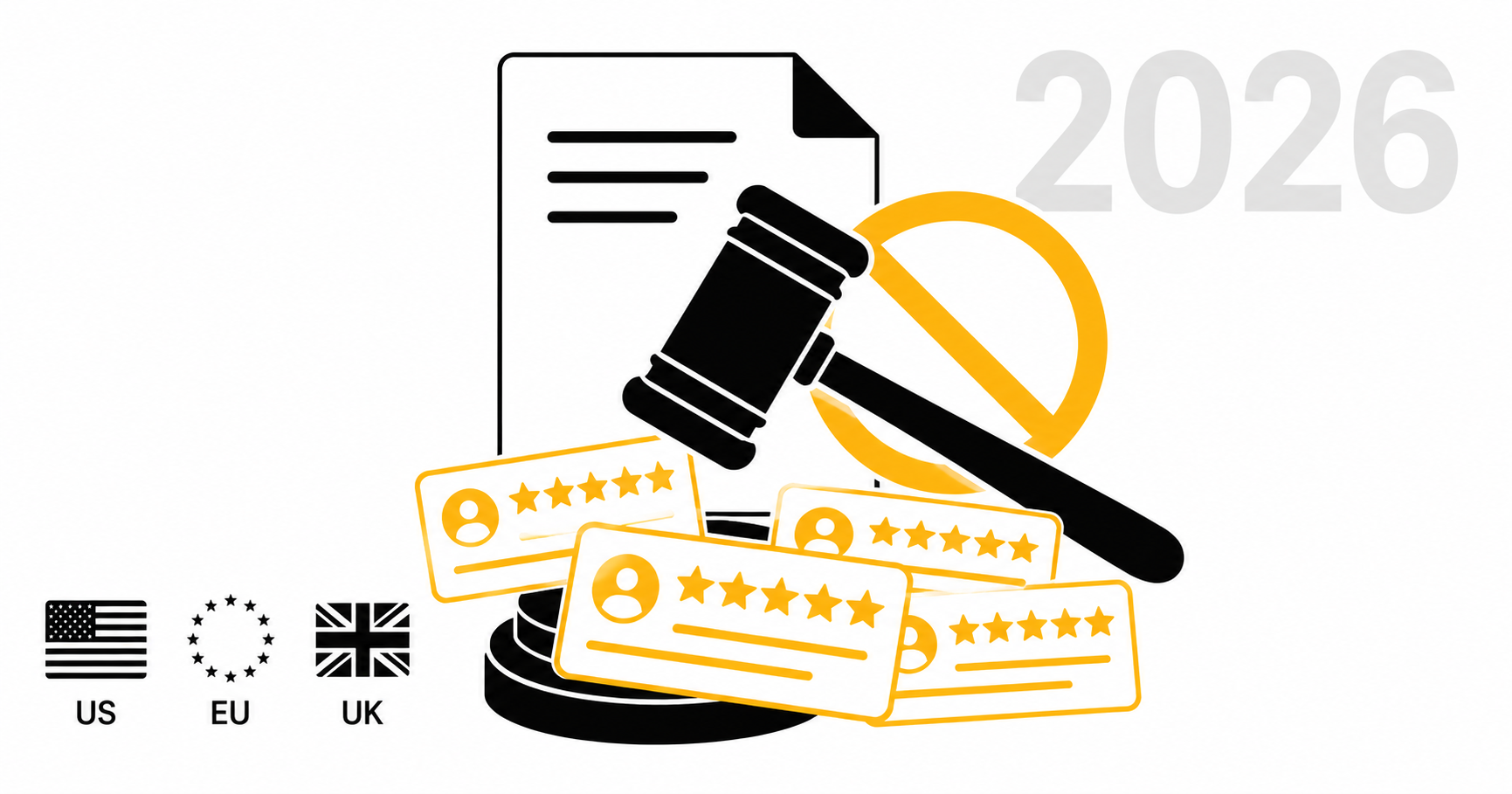
For a long time, buying or posting fake reviews felt like a grey area - ethically questionable, but rarely something that got businesses into serious legal trouble. That's changed significantly in recent years, and 2026 is a very different landscape from even five years ago.
The short answer to the question is: yes, in many jurisdictions, fake reviews are now clearly illegal. And the consequences are getting more serious.
What counts as a "fake review" legally?
Before getting into the specifics, it's worth being clear about what we're talking about. Legally, the category of problematic reviews typically includes:
Paid reviews - paying individuals or services to post
positive reviews, whether or not those people have used your product or
service.
Incentivised reviews without disclosure - offering discounts, gifts, or other benefits in exchange for reviews, without making that relationship clear to readers.
Reviews written by the business itself - employees or owners posting reviews pretending to be customers.
Competitor attacks - paying for or coordinating negative reviews targeting a rival business.
Review suppression schemes - some platforms and businesses have faced action for paying to hide or remove negative reviews.
The legal landscape in 2026
United States
The Federal Trade Commission (FTC) has been the most active regulator in this space. In 2023, the FTC proposed a rule explicitly banning fake reviews and testimonials. That rule was finalised and came into effect in 2024, making it one of the clearest legal frameworks anywhere in the world.
Under the FTC's rules, businesses can face civil penalties for buying fake reviews, creating fake consumer reviews, or failing to disclose material connections between a reviewer and a business. Penalties can run to tens of thousands of dollars per violation - and because fake review campaigns typically involve many individual reviews, the numbers can escalate quickly.
The FTC has also taken action against companies that used "review gating" - a practice where businesses only direct satisfied customers to leave reviews while filtering out dissatisfied ones. This is considered deceptive under consumer protection law.
European Union
The EU has taken a similarly hard line, with the Digital Services Act and updates to the Omnibus Directive specifically targeting fake reviews. From 2023 onwards, EU member states were required to implement rules ensuring that businesses publishing consumer reviews must have processes in place to verify their authenticity.
Under these rules, it's illegal for businesses to submit fake reviews or to pay for them. Businesses that publish consumer reviews must also disclose whether and how they verify those reviews. Violations can result in fines of up to 4% of global annual turnover in some member states - a number that gets attention at board level.
United Kingdom
Post-Brexit, the UK has maintained and strengthened its own approach through the Competition and Markets Authority (CMA). The CMA has investigated and taken action against multiple platforms and businesses over fake review practices, and the Digital Markets, Competition and Consumers Act introduced in 2024 brought clearer enforcement powers.
Businesses facilitating or engaging in fake review practices in the UK can face enforcement action, significant fines, and reputational consequences from CMA investigations - which tend to be public.
Other jurisdictions
Australia, Canada, and a growing number of other countries have also updated their consumer protection frameworks to address fake reviews more explicitly. The global trend is clearly in one direction: regulators are treating fake reviews as a form of consumer fraud, not just an ethical lapse.
What this means if you're a business
If you're currently buying reviews, incentivising them without disclosure, or turning a blind eye to employees posting as customers - the legal risk is now real and growing.
Beyond the direct penalties, there's also the reputational risk. Enforcement actions and investigations tend to be public. Being named in an FTC action or a CMA investigation does lasting damage to consumer trust - particularly for businesses in sectors where that trust is already hard to build.
The smarter approach - both legally and commercially - is to build your review presence the right way, with genuine feedback from real customers. It takes longer. It's also the only approach that isn't sitting on a legal and reputational time bomb.
What this means if you're a consumer
These legal developments are a good sign, but they don't mean fake reviews have disappeared. Enforcement is still patchy, particularly for smaller businesses and for operations based in jurisdictions with lighter regulation. You should still approach reviews critically, use platforms with strong verification standards, and treat suspiciously perfect rating profiles with healthy scepticism.
Why RedAlertCheck's approach matters in this context
The regulatory direction of travel is clear: review platforms are increasingly expected to verify their reviews and be transparent about their moderation processes. RedAlertCheck has been ahead of this curve.
Our AI-powered verification system ensures that every review published on our platform has been screened for authenticity before going live. We're not waiting for regulators to tell us to do this - it's fundamental to what the platform is for. When you publish a review on RedAlertCheck, or read one, you're operating on a platform that takes verification seriously as a legal and ethical obligation.
That's the standard the industry is moving towards. We're already there.
Related posts:
Can Competitors Leave Fake Reviews on Your Business?
How Can You Spot Fake Reviews?
How Do I Get More Genuine Reviews?
Comments (0)